Responsibility Chart for Kids: Chores vs Routines vs Rewards
Responsibility chart for kids: learn how it differs from chores, routines and rewards, what a good one needs, and how to choose safe tasks.
By Kids Daily Responsibilities Chart by Cosmo Suite · Editorial policy
Published · 6 min read
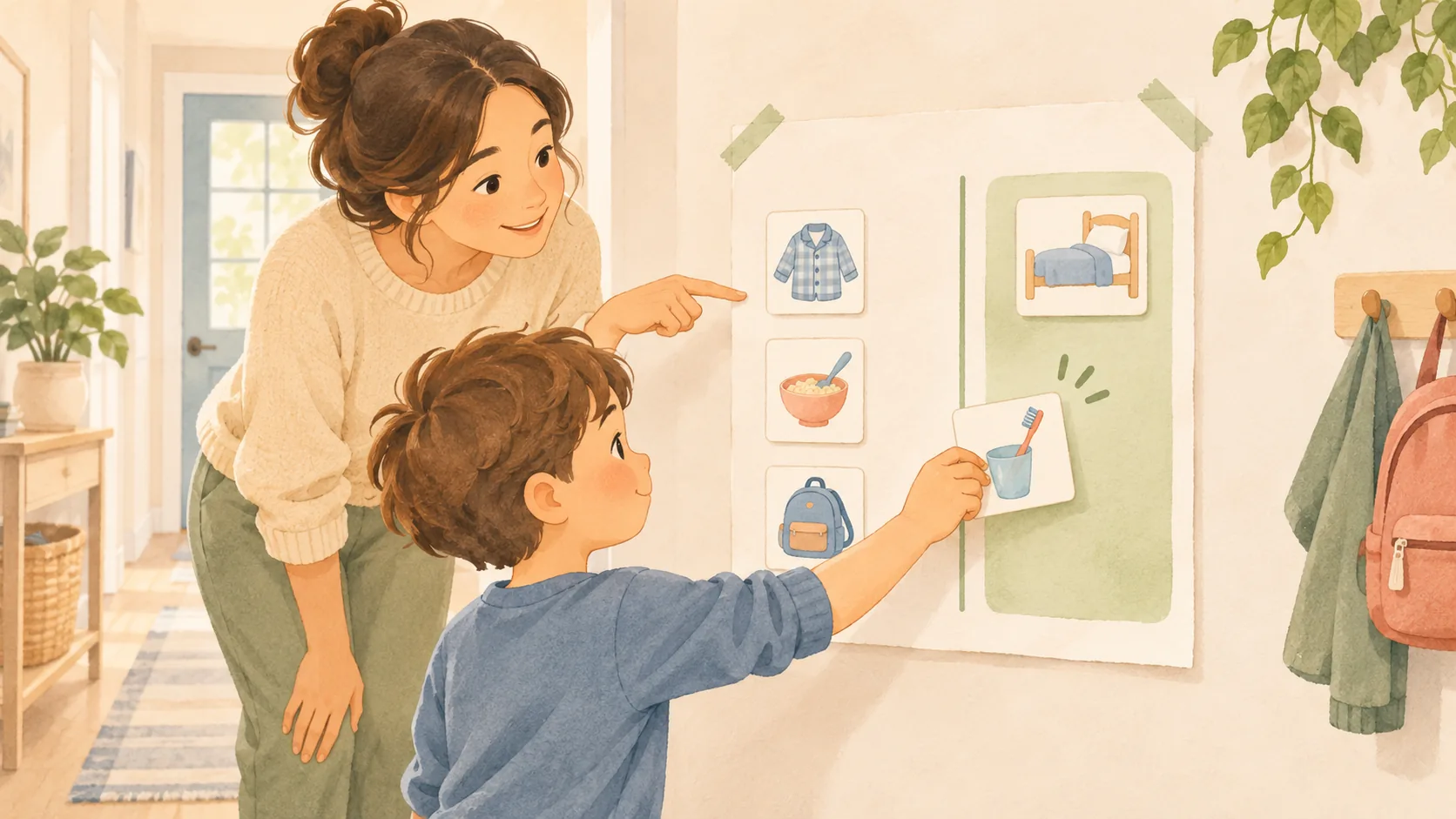
Search for a responsibility chart and you get star grids, chore lists and routine strips, all under one name. It is hard to tell which one you are looking at, and which one your family needs.
This guide separates chores, routine steps and rewards, then gives you five checks you can run on any chart. It also covers where a picture version of the chart fits, for kids who can't read yet.
If you have been the one saying "did you brush your teeth?" every morning, the useful question is who does the reminding. A printable picture chart for kids can hold that job, but only if the chart itself is set up well.
Key takeaways:
- A responsibility chart shows a child's own jobs and where to mark them done.
- A chart can hold chores and routine steps without any rewards.
- Five checks tell you whether a chart will run without you rewriting it.
- Start with a few jobs, add one at a time, and keep every job safe.
What is a responsibility chart for kids?
A responsibility chart is a board that shows a child the jobs that are theirs each day and gives them a place to mark each one done. It does not track behavior or keep points.
This is our own working definition, not a standard one. "Responsibility" here means a job that belongs to the child, as opposed to a task an adult hands over fresh each time.
It can use words or pictures. For a child who can't read yet, pictures make more sense, and the picture chart guide covers how to teach each one.
How is a responsibility chart different from a chore chart?
Often it is the same board under a different name. We split the words four ways in plain language, because search results blur them together.
| Term | What it is | Who decides | Does the chart need it? |
|---|---|---|---|
| Responsibility | A job that is the child's own each day | The family sets it | Yes, it is the reason the chart exists |
| Chore | A household job, such as putting toys away | An adult chooses and teaches it | A chart can hold chores |
| Routine | The same steps in the same order, such as the morning | An adult sets the order | A chart can show it |
| Reward | Praise, a treat, money or points | The family, separately | No |
This table is our own split.
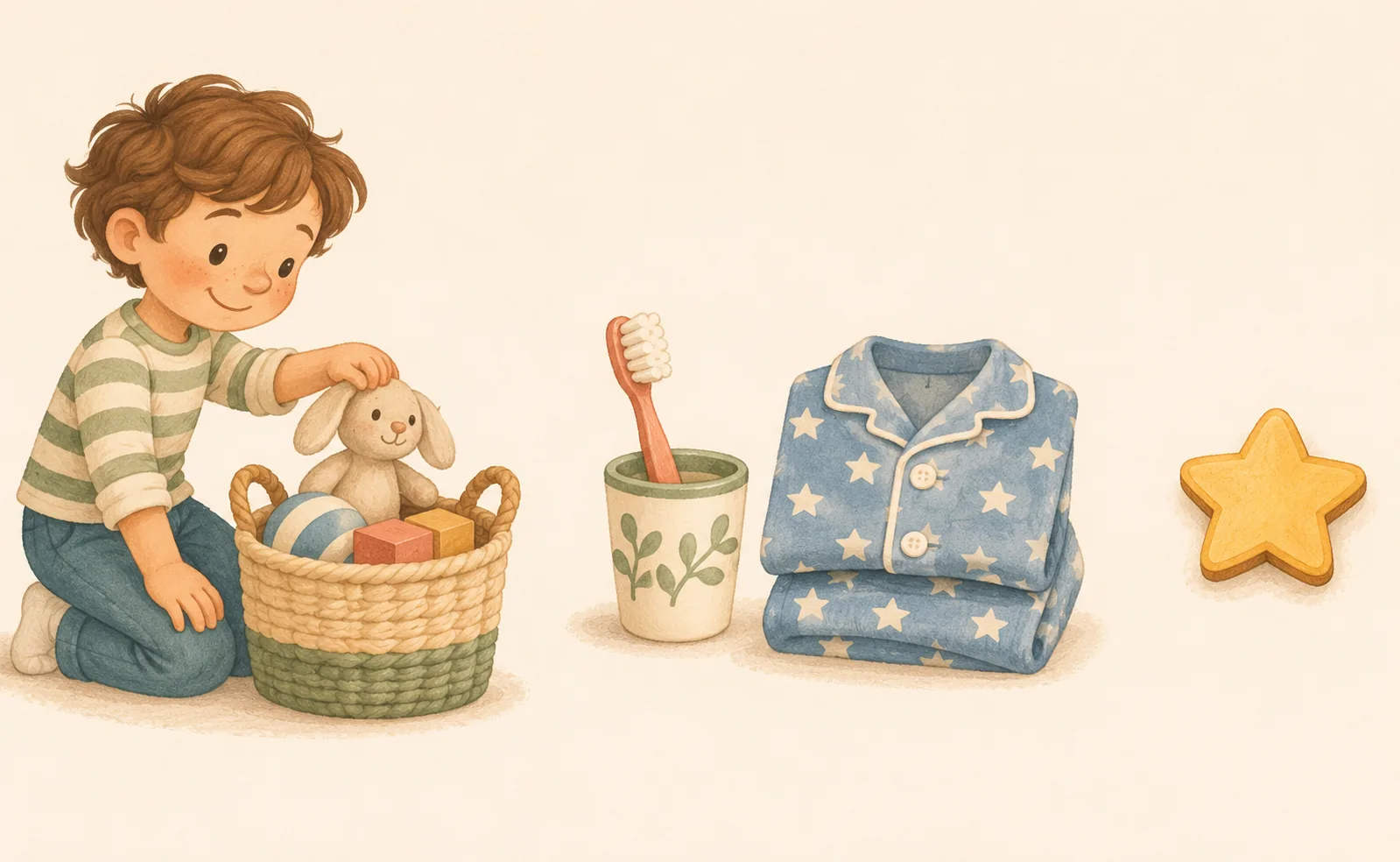
Routines are a natural fit for a board. If mornings are the pressure point, see six steps before school. If it is evenings, look at an evening column that ends at lights out.
The CDC says routines should match a child's capability. The family decides how a routine looks in their home.
What makes a good responsibility chart?
A good one passes five checks, and none of them needs points. These are our checks, built from the ways paper charts commonly stall: a parent rewrites the list, resets the board and ends up doing the reminding.
- The child can see what is theirs without being read to. If you have to say the list aloud, you are still doing the reminding.
- Each job is one this child can safely do. An adult stays nearby for new or risky jobs. The CDC says to assign only safe tasks.
- The child, not the parent, marks a job done. If you move the cards, the chart is your job, not theirs.
- There is nothing to rewrite or reset beyond putting cards back. A chart that needs redrawing every few days keeps you running it.
- A missed job does not make the next day harder to start. You can reset the chart and try the routine again without turning missed boxes into a penalty.
Check 2 draws on the CDC's safety guidance and the AAP's advice to supervise. Checks 1, 3, 4 and 5 are our reasoning. You can run all five on any chart, including our morning and evening picture cards.
Even a chart that passes all five will not run itself on day one. If your child ignores it, see what to do when they ignore the chart.
Does a responsibility chart need points or rewards?
No. The chart's job is to show what is next and what is finished. Rewards, if your family uses any, are a separate decision.
Stars and checkbox grids are one common way to fill a chart, but they are not part of the definition. Adding a reward means more decisions for you: what counts, and how you will handle it. We take no side on whether rewards help or hurt, since families differ.
How many responsibilities should a child have?
There is no universal number that fits every child. Choose tasks that match your child's skills, and introduce them one at a time when the routine is new.
The American Academy of Pediatrics says most preschool-age children can start simple household tasks. For a school-age child who is new to chores, it advises introducing one new task at a time because a long list can feel overwhelming. It also recommends spelling out expectations and supervising. The CDC says routines should fit a child's capabilities and adults should assign only safe tasks. Utah State University Extension groups kitchen chores into four age bands: 2-3, 4-6, 7-11 and 11+. Use any age band as a starting point, since your child's ability and the task's safety matter too. You do not have to fill every space.
A 2025 Journal of Family Psychology study examined preschool routines, including chores. Researchers used Year 3 and Year 5 data for 2,353 children; 48% were female (sample details). They grouped children into four routine profiles, and 75% stayed in the same profile across both measurements (profile results). Parents reported above-average routines for 77% of children at age 3 and 86% at age 5 (routine results). Among families below average at age 3, routine use was above average for 74% by age 5; 7% moved from high to low routine use (routine results). Children in the stable-high profile had fewer reported attentional, externalizing and internalizing problems than children in the decreasing group (outcome results). Parents reported both routine use and outcomes, so the results show an association and do not establish causation; the study did not evaluate printable charts (study limitations).
For a first set, see starting with two or three picture jobs. For an older child, there is a morning and evening set for a five-year-old.
What if your child can't read yet?
Use a picture for each job and teach each picture before you rely on it.
Keep one clear action per picture. Do the job together a few times, then point to the card. The American Academy of Pediatrics recommends spelling out chores clearly and supervising. The picture makes the next action easier to see, but you still check that the job is safe.
What does one board look like?
Here is one example. The board has three areas: Morning, Evening and Done. The cards below are examples only.
| Area | Example card | What happens |
|---|---|---|
| Morning | Brush teeth | The child sees a familiar job in the morning row. |
| Evening | Pick up toys | The child sees the job in the evening row. |
| Done | A completed card | The child moves a finished card here. |
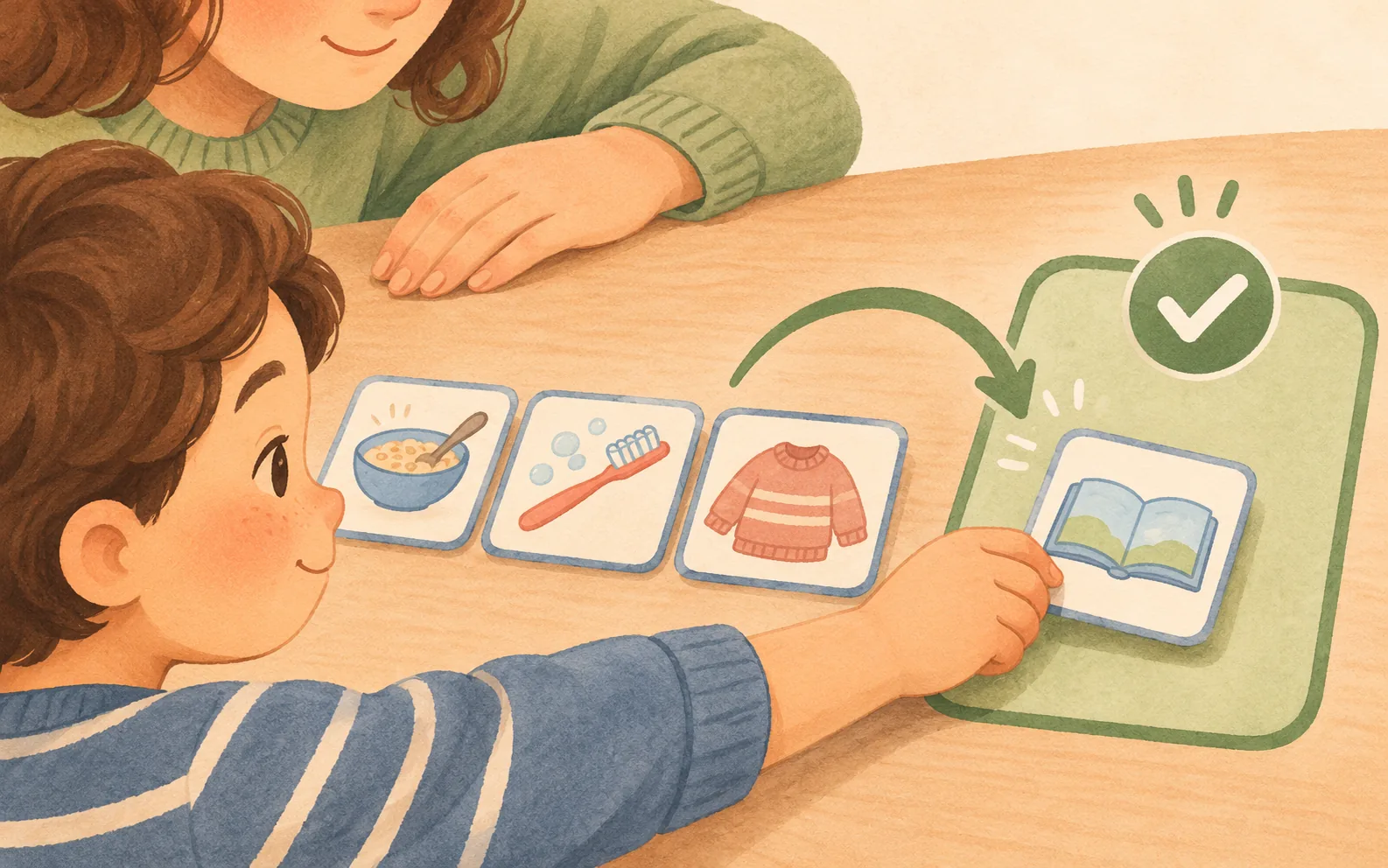
Say you pick a few cards for a young child, such as potty and brush teeth. For an older child, you might pick laundry or dishwasher. Each card sits in Morning or Evening until your child moves it to Done.
Why trust this article?
The byline is the organization, with no named parent or expert. We created this printable, so we have a stake in what you choose. We drew on the American Academy of Pediatrics and CDC pages listed in the sources, and checked them on 17 November 2026. The three-way split and the five checks are our own, not from a study. See about us and our editorial policy.
What comes with the printable?
Kids Daily Responsibilities Chart is a printable chart for families who want picture prompts for daily jobs. The package includes:
| Included | Details |
|---|---|
| Boards | 3, one per child |
| Areas | Morning (6 slots), Evening (6 slots) and Done (12 slots) |
| Picture cards | 60 chore cards and 6 blank cards for family jobs |
| File | Printable PDF files |
| Setup | Print, cut and stick |
You choose which jobs belong on each board. If this setup fits, see the printable.
Frequently asked questions
Is a responsibility chart the same as a chore chart?
Often it is the same board with a different name. A chore chart lists household jobs. A responsibility chart stresses that the jobs belong to the child, and it can also hold routine steps such as brushing teeth. What matters is what is on the board and who moves it, not the title.
What counts as a responsibility for a young child?
A job that is theirs each day, that they can safely do, and that you have shown them first. Our working rule is simple: if you would still be doing it for them, it is not yet their job. The American Academy of Pediatrics says most preschoolers can start simple household tasks. Which task fits depends on your child's skills and the risks involved.
Can a responsibility chart hold routine steps as well as chores?
Yes. A chart can carry household jobs, daily routine steps, or both. Keep morning and evening jobs in separate groups so your child looks at the right set at the right time.
Do I need stickers, stars or points on the chart?
No. Stickers, stars and points are one way some families fill a chart, but they are not part of what a responsibility chart is. Whether to use any reward is a separate family choice, and you can add or skip it without changing the chart.
What age can use a responsibility chart?
There is no single age. The American Academy of Pediatrics says most preschoolers can start simple household tasks, and the CDC says to match routines to a child's capability and assign only safe tasks. Pick jobs for your child, and supervise while a job is new.
Can a child who can't read use one?
Yes, if each job has a clear picture and you teach what the picture means first. Do the job together a few times, then use the picture as the reminder. A picture does not replace showing the task or checking that it is safe.
Is the printable editable?
No. The product is a printable PDF, not an editable form. It includes three boards, 60 picture cards and 6 blank cards. The setup guide covers printing, cutting and sticking.