How to Get Kids to Do Chores Without Reminding Them All Day
How to get kids to do chores: choose one clear job, teach it together, then use a picture cue while you keep helping and reminding as the routine takes shape.
By Kids Daily Responsibilities Chart by Cosmo Suite · Editorial policy
Published · 8 min read
For example, you repeat the toothbrush reminder, have the argument, then do it yourself. The plan for the morning still lives only in your head. The American Academy of Pediatrics (AAP) notes that children may procrastinate or need reminders as they take on chores.
This guide shows how a picture chore chart can make the next chore visible while you keep teaching and checking each task. Start with a few jobs, teach each one, and make "what's next" something your child can see. A picture can replace a long spoken list with one visible cue, but it will not remove reminders.
A chore chart is a visual list of a child's jobs with a place to show what is finished.
Key takeaways:
- Start with a few jobs and teach each one before you rely on it.
- Make "what's next" something your child can see, not only hear.
- Expect to keep reminding young children. Point to the board instead of repeating the list.
- Keep safety, checking and resets with the adult.
Why do kids need so many reminders?
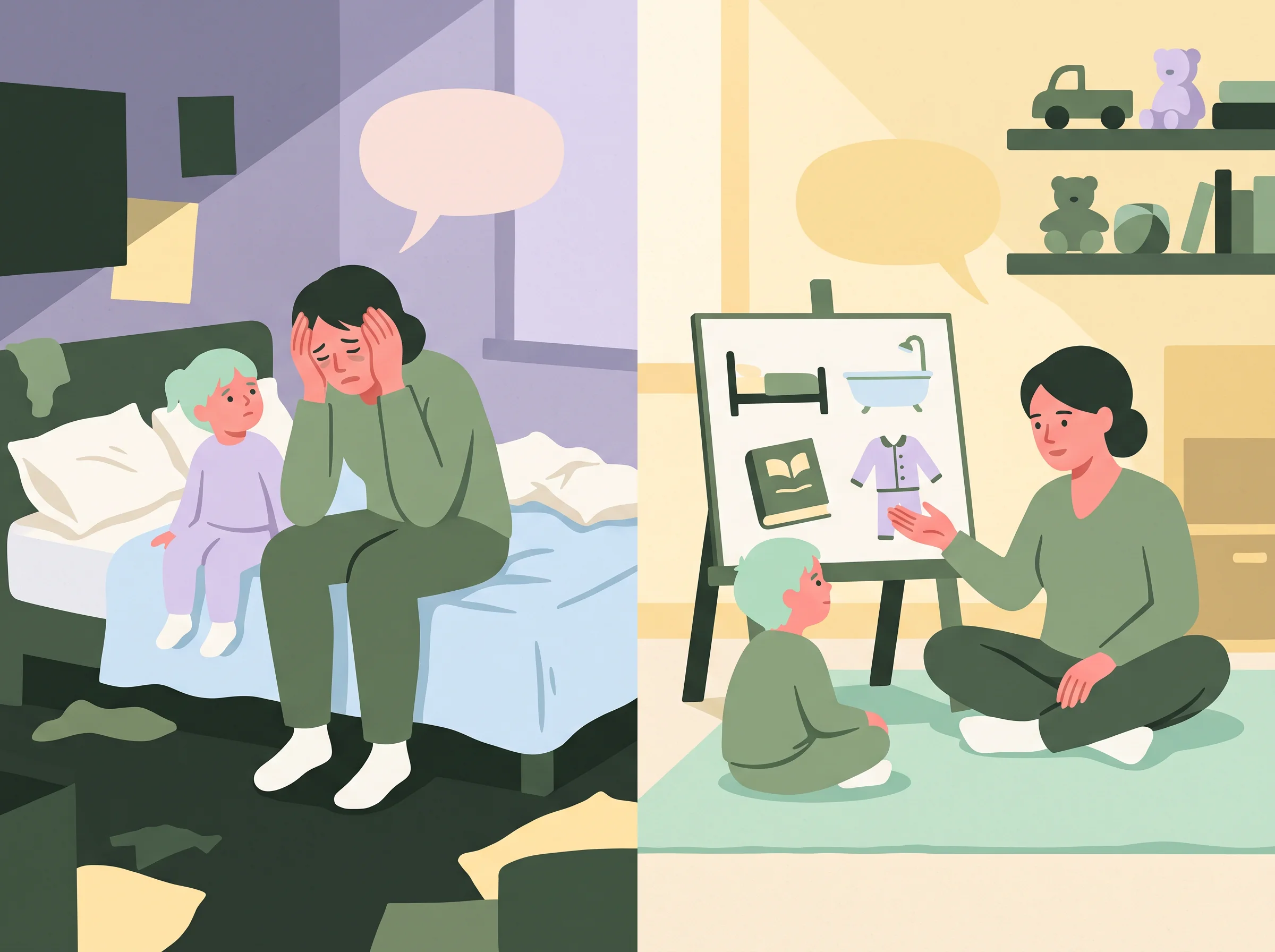
One reason you may find yourself repeating chores is that the routine lives in your head, so each step has to be said aloud. Your child hears a whole list at once, follows the first item, and usually loses track of the remaining instructions.
As an example, the loop can look like this:
- You remind.
- Your child stalls, or says no.
- You argue about a job that should take a few minutes.
- You do it yourself to save time.
- Any list or chart you started goes quiet, because it only worked while you kept running it.
Young children also forget, get pulled toward a toy halfway across the room, and may not be sure what "get ready" means. That is a reason to make the next action easy to see, not a reason to label a child as unwilling.
The loop can change when "what's next" has a visible place outside your memory. A printable picture chore chart with Morning, Evening and Done areas is one way to set up that cue. It cannot make reminders vanish, but it gives you something to point to while your child learns the routine.
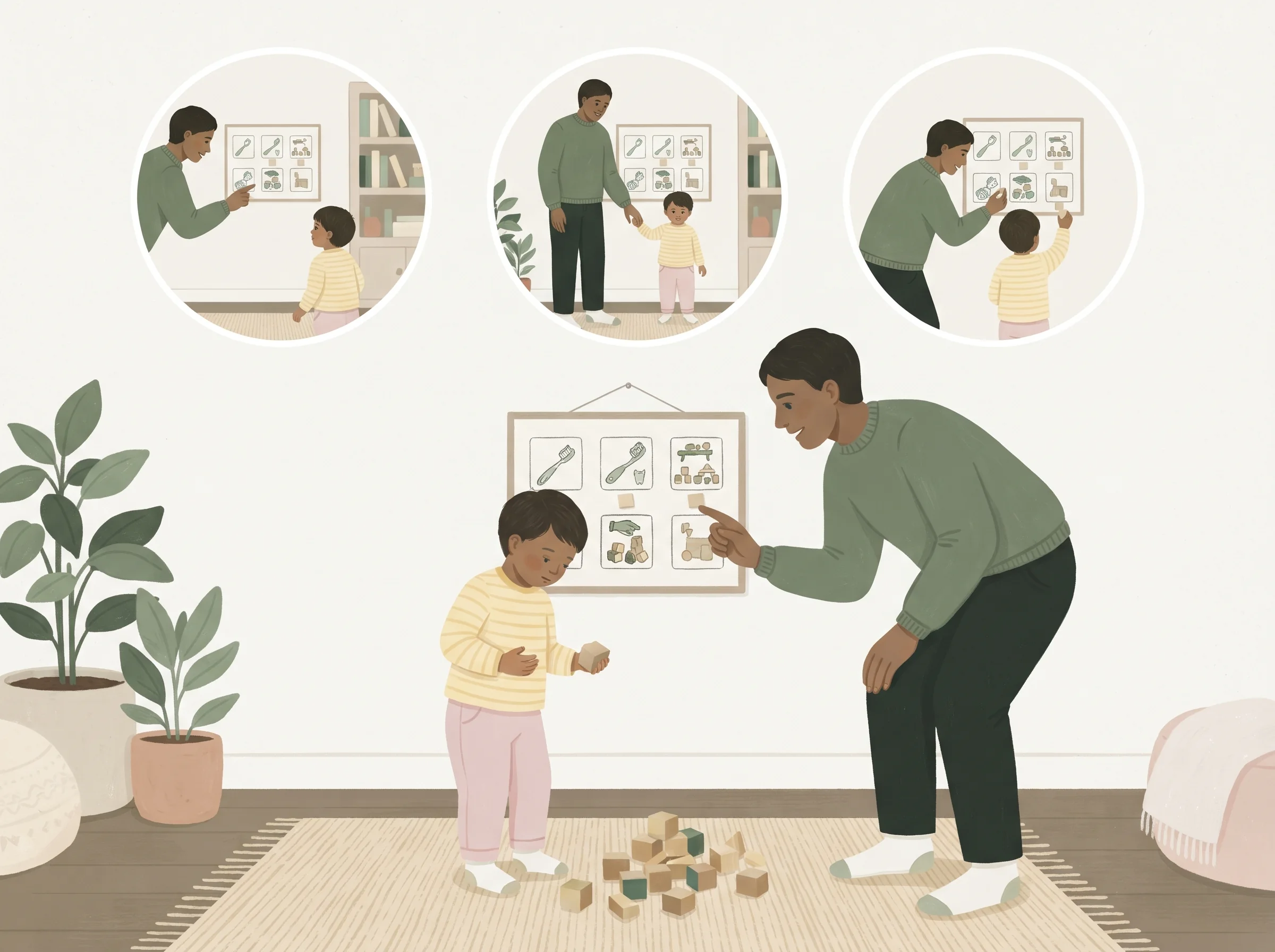
Which chores should you start with?
Start with a few safe responsibilities that happen every day and have one clear action. The AAP says most preschool-age children can begin simple household tasks, with examples varying by child. The CDC guide to routines and rules advises tailoring tasks to a child's abilities and assigning only safe ones.
These are examples to adapt, not a required set. The "why start here" column matters more than the job name.
| Job | Why start here | Adult does |
|---|---|---|
| Put toys away | Happens in the same place every day, and finished is easy to see | Shows where each kind of toy goes, then checks the floor |
| Put pajamas in the hamper | One clear action with a clear destination | Keeps the hamper where your child can reach it |
| Brush teeth | Already part of the day, so it attaches to a routine you have | Stays close and checks the finished job |
| Get dressed | Gives the morning a visible first step | Lays out clothes the child can manage |
Pick one or two to begin, because you do not need to fill every slot on the board during the first week. For one age-specific example, see the chore chart for a 5 year old.
How do you teach a chore so it sticks?
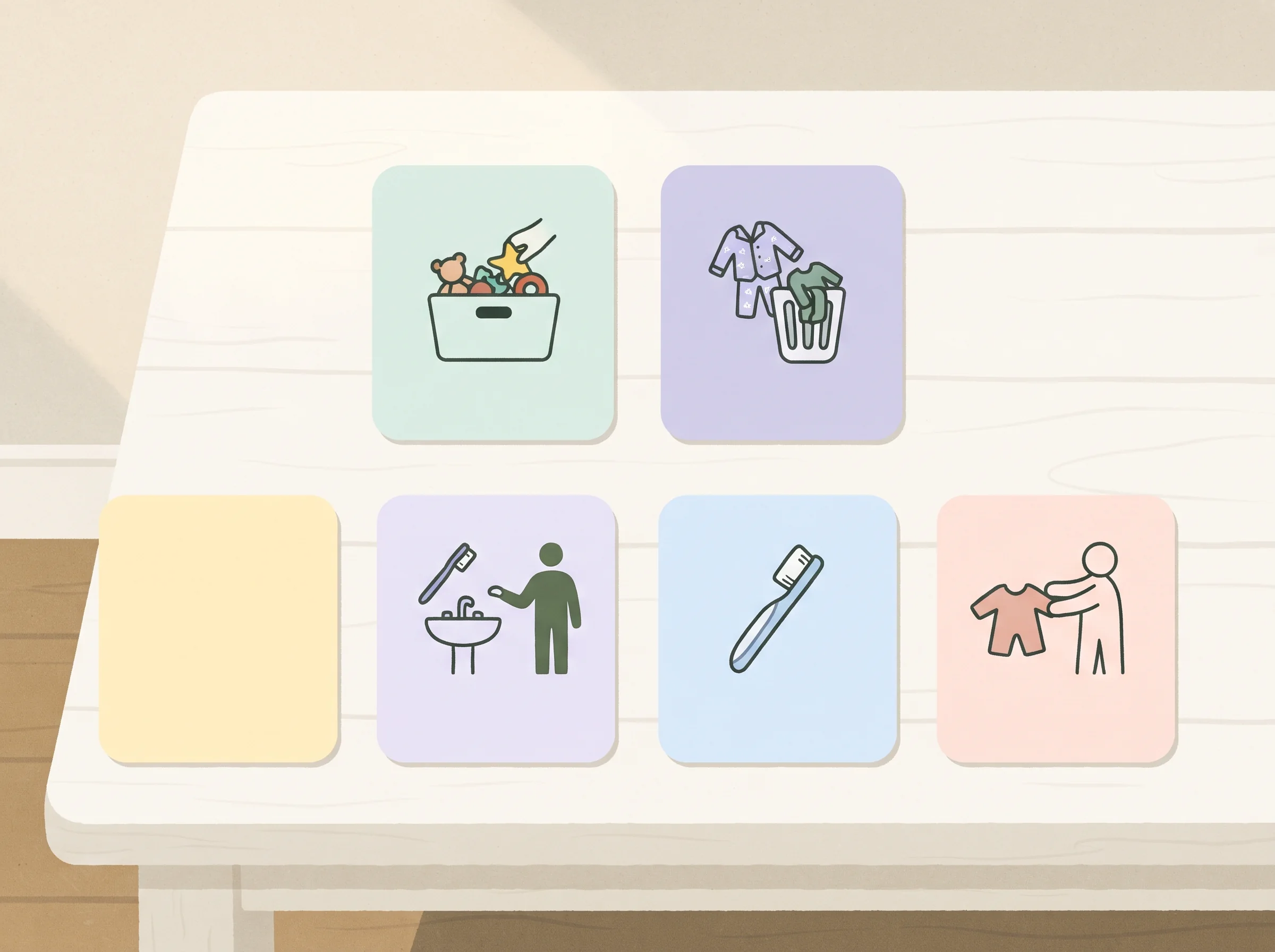
Show the job, do it together, let your child try, and stay close while they do. A card on a wall cannot teach a job; it can only remind a child of something they already understand how to do independently.
Here is a simple order to follow:
- Show it. Do the job slowly while your child watches, and say what you are doing in a few words.
- Do it together. Let your child's hands do part of it while yours do the rest.
- Let them try. Step back a little, but stay in the room.
- Check it with them. Look at the finished job together and fix anything small without a lecture.
- Repeat with the same words. Use the same short phrase each time so the words and the job stay connected.
For a school-age child who is new to chores, the AAP advises introducing one new task at a time because a long list can feel overwhelming. See its age-appropriate chores guidance. If your child is still learning toy tidying, wait before adding laundry.
Specific directions also help. "Put these pajamas in the hamper" is easier to follow than "get ready." The same AAP guide recommends clear expectations, consistent routines, and spelling out daily and weekly tasks. How far you break a job down depends on your child.
When a responsibility does not get done, ask whether your child was taught it. A skipped job is often a gap in teaching, not defiance. The practical solution is usually to practice again or make the responsibility smaller, which is our recommendation rather than a finding from either source.
What should the chart do instead of you?
A chart gives you a short cue to try: "Check your board." The AAP describes a chore chart or checklist as a visual reminder. You still need to demonstrate each responsibility and personally check the finished result.
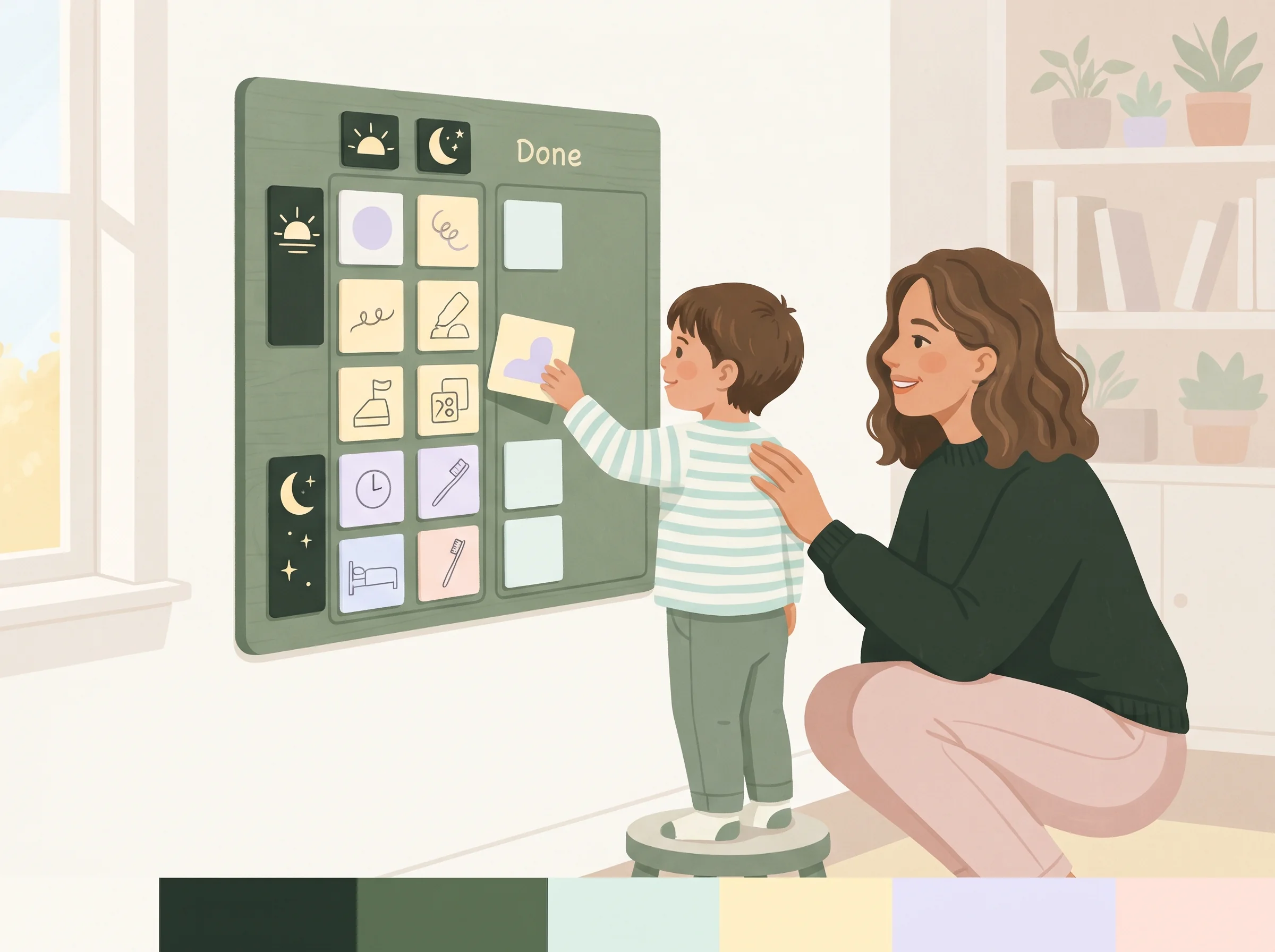
The picture chore chart method covers the card setup in detail. In short, Kids Daily Responsibilities Chart has a Morning column with six slots, an Evening column with six slots, and a Done column with twelve.
Keep the limit in view: young children need frequent reminders, and the chart is one visible cue, not a replacement for you. Expect to point at the board often while the routine is new, and with a 3 or 4 year old, expect to continue doing so for a considerable period; nothing here is a timeline or a guarantee.
The jobs split like this:
You:
- Teach each job and decide which jobs are safe.
- Place the board where the routine happens.
- Reset the cards with your child.
- Check the finished job.
Your child:
- Looks at the board.
- Does the job.
- Moves the card to Done.
Before you rely on a picture cue, check that your child recognizes the picture and knows the matching job. If a picture is confusing, show the job again or use one of the blank cards to make the cue clearer. Put the board close to the routine, such as by the place where your child gets dressed, but choose a spot that is safe and easy for them to reach.
For example, suppose a four-year-old gets stuck when it is time to put toys away. Start with one basket and a few familiar toys. Show where they go, do a couple together, then let the child try while you stay nearby. The board can show the next step, but your demonstration teaches what the picture means. Keep that job on the routine until the child recognizes it. Add pajamas later if the first task is clear and safe. This is an example to adapt, not a timeline for every child.
If you want the board itself, the printable chart with Morning, Evening and Done areas is built for this split.
What do you say when they ignore the chart?
Try one short cue and keep the wording steady. The table compares two ways to handle the same evening. It is an example for a child of about 4 to 6, not a real family or a measured result.
| Moment | Spoken list from memory | One cue from the board |
|---|---|---|
| Before dinner | "Did you put your toys away? Where did you leave your shoes?" | "Check your board." |
| After dinner | "Pajamas in the hamper, then teeth, hurry up." | "What's next on your board?" |
| Before the bath | "Did you do your teeth? Did you do the toys? Why is this still out?" | You point at the next card and wait. |
The cue is shorter, although your supervision and checking responsibilities do not disappear.
If your child skips a card, try a three-step ladder:
- Ask, "What's next on your board?"
- Point at the card.
- Walk over and do the first step together.
This approach is meant to reduce the number of spoken words rather than eliminate reminders entirely, and a young child may need the ladder many times.
If the card moves but the job is not done, check whether your child understands the picture. Practice the job together, split it into smaller steps, or take one off for now. The card is a cue, so you still need to check the task.
Rewards are optional, and the call is yours. Kids Daily Responsibilities Chart has no points or money built in, so it works with or without them. We make no claim about whether rewards help or hurt.
Why do chore charts stop working?
Even a paper chart needs upkeep: a handwritten list needs rewriting, a whiteboard needs resetting, and cards need to be put back for the next routine.
Paper cards can avoid rewriting the job list, although you still help your child reset them for the following routine, so the chart requires some regular maintenance.
The CDC advises tailoring routines to your child's abilities, keeping them predictable, and communicating changes when you are both calm. See its routines and rules guidance for the full advice. Keep the order familiar when it suits your household, and explain changes before a stressful moment.
When the board stops working, shrink the list of responsibilities before you decide the whole approach has failed.
Why Trust This Article
Kids Daily Responsibilities Chart is a Cosmo Suite printable. We checked the American Academy of Pediatrics and CDC guidance linked here on November 15, 2026. The worked routine is an example, not a tested result. Product details come from the printable contents list. This is general information, not an assessment of your child or home.
You can read more about us, see how we write and check posts in our editorial policy, or contact us if something here looks wrong.
How Kids Daily Responsibilities Chart Fits
Kids Daily Responsibilities Chart is a printable PDF on US Letter paper. It is not editable. It includes three boards, each with Morning, Evening and Done areas, plus 60 picture chore cards and 6 blank cards. They range from toddler jobs such as potty and brushing teeth to older-kid jobs such as laundry, dishwasher, walking the dog and yard work.
It takes some assembly. You print the PDF, cut out the cards and place them on the boards. Cardstock is suggested, while laminating and Velcro are optional additions; there is no application, account, points or money built in.
For a paper chart with separate boards and picture cards, see the Kids Daily Responsibilities Chart printable.
Frequently asked questions
What chores can a 3 or 4 year old actually do?
The American Academy of Pediatrics says most preschool-age children can begin simple household tasks, though examples vary by age. A parent might try a small, supervised version of putting toys away if it suits the child. Choose a job your child can safely practice, and stay close while they learn it.
How many chores should a young child have at once?
There is no required number. Start with one or two jobs and add a new one only when the current job feels familiar. For a school-age child who is new to chores, the American Academy of Pediatrics advises introducing one task at a time because a long list can feel overwhelming. A board with empty slots is fine.
Should I pay my kids to do chores?
That is your family's call. Some families connect chores to rewards, and others do not. Kids Daily Responsibilities Chart has no money or points built in. You can make the reward decision separately from the chart and use it either way.
What if my child still says no?
Start by checking whether the job is clear, safe and small enough, and whether your child has learned it. Practice together, split it into smaller steps, or take one off for now. If you have a broader concern about your child, talk with their clinician.
Do I need an app or screen?
No. The chart is paper. You print the PDF on US Letter paper, cut out the cards and place them on the board. Cardstock is suggested, and laminating and Velcro are optional. It takes some assembly, but there is no app, account or screen involved.
Can I use one chart for siblings?
Yes. The current printable PDF includes three boards, so siblings can use separate ones. Choose each child's jobs to fit their age and abilities. A shared household routine may still work for both, but the board does not decide which tasks are safe in your home.
Will I still have to remind my child?
Yes. Young children need frequent reminders, and a chart does not change that. It gives you one visible cue to point to instead of repeating a whole list. Keep teaching and checking the job while the routine is new. There is no set point when a child stops needing reminders.
